Serverless vs. Containers in 2026: Choosing the Right Architecture
The debate has evolved. In 2026, most production workloads aren't choosing between serverless and containers — they're choosing when to use each. Here's the framework that helps you decide.
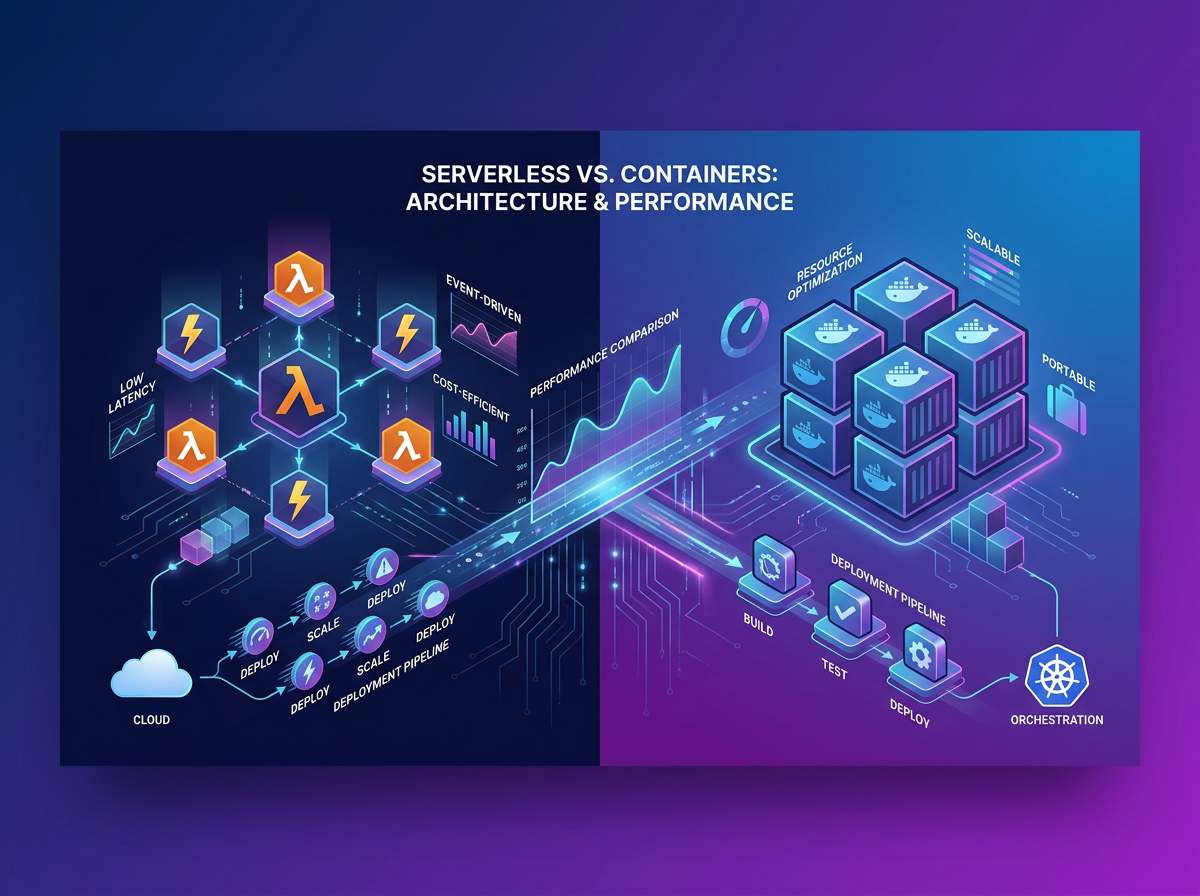
The Convergence Nobody Predicted
Five years ago, the serverless vs. containers debate felt binary. You either embraced AWS Lambda's event-driven model or you ran Kubernetes clusters. Today, the boundary has blurred significantly. AWS Lambda now supports containers up to 10GB. Google Cloud Run bridges both worlds. Azure Container Apps offers serverless scaling for containerised workloads. The tooling has converged — the architectural decisions haven't.
The question in 2026 isn't "serverless or containers?" — it's "what properties does this workload need, and which approach provides them at the lowest operational cost?"
What Serverless Does Exceptionally Well
Serverless excels in specific, well-understood scenarios. Understanding these scenarios is the key to using it correctly rather than evangelising it wholesale.
Event-driven processing at variable scale — S3 file uploads triggering processing pipelines, API webhooks, IoT event streams, scheduled batch jobs. The on-demand scaling model means you pay for execution time, not idle capacity. For spiky, intermittent workloads, this delivers cost savings of 60-80% compared to always-on container deployments.
Rapid prototyping and MVPs — The operational overhead of serverless is genuinely low. No cluster management, no capacity planning, no node upgrades. For teams moving fast on new products, this removes significant friction.
Glue code and integration functions — API Gateway integrations, data transformation functions, authentication flows — these are perfect serverless workloads. Short execution times, stateless operation, clear inputs and outputs.
The cold start caveat — Cold start latency remains the most significant serverless limitation in 2026. AWS Lambda cold starts for JVM-based workloads can still add 1-3 seconds of latency. Solutions exist (Provisioned Concurrency, GraalVM native compilation, SnapStart) but they add complexity and cost. For latency-sensitive synchronous APIs, cold starts remain a real concern.
Where Containers Win
Containers have also matured significantly. The operational overhead of running Kubernetes has been substantially reduced by managed services (EKS, GKE, AKS) and tools like Helm, Flux, and ArgoCD. Here's where containers maintain a clear advantage:
Long-running, stateful workloads — Database connections, in-memory caches, WebSocket connections, background job processors. These workloads need persistent state and often warm connections — the serverless model works against them.
ML inference and GPU workloads — Loading ML models into memory takes time and memory. Serverless functions are too constrained and too short-lived for most inference workloads. Containers on GPU nodes remain the standard pattern for model serving.
Predictable, high-traffic APIs — For APIs handling consistent, high-volume traffic, the economics often favour containers on Reserved Instance or Savings Plan pricing over serverless per-invocation costs. The break-even point varies by workload but typically falls around 1-2 million requests per day.
Complex microservices with service mesh requirements — When you need mutual TLS, distributed tracing, circuit breakers, and advanced load balancing between services, Kubernetes with a service mesh (Istio, Linkerd) provides capabilities that serverless architectures struggle to replicate.
The Hybrid Reality
The most effective architectures in 2026 use both. A typical pattern: containerised microservices handle core business logic and synchronous APIs, while serverless functions handle event processing, scheduled jobs, and integration workflows. This isn't architectural indecision — it's appropriate tool selection.
AWS App Runner, Google Cloud Run, and Azure Container Apps have made this hybrid model easier to operate. These managed container services offer serverless-like scaling (scale to zero, pay-per-use) with container-level flexibility. For many workloads, they offer the best of both worlds.
A Decision Framework
When evaluating whether serverless or containers are right for a workload, ask these questions:
What's the execution pattern? — Short, event-triggered functions favour serverless. Long-running, persistent workloads favour containers.
What's the traffic pattern? — Spiky and unpredictable favours serverless economics. High and consistent favours container economics with reserved capacity.
What are the latency requirements? — If P99 latency under cold-start conditions is unacceptable, serverless needs careful engineering or may not be appropriate.
What's the team's operational maturity? — Serverless removes infrastructure operations but adds function management complexity. Containers require more upfront operational investment but offer more control at scale.
What does the runtime require? — Heavy dependencies, GPU access, specific OS-level requirements, long initialisation times — these point toward containers.
Looking Ahead
The most interesting development in this space is the continued convergence. WASM (WebAssembly) runtimes like WasmEdge and Spin are emerging as a third execution model — faster cold starts than Lambda, more portable than containers, with an isolation model that sits between the two. Keep an eye on this space: by 2027, WASM may be a legitimate third column in your compute architecture.
For now, the practical advice is straightforward: stop treating this as an either/or choice. Model your workloads against the framework above, pick the right execution model for each service, and invest in the platform engineering foundations (observability, CI/CD, cost visibility) that make both approaches manageable at scale.

How CBM Can Help
Architecture Decisions That Scale
CBM architects cloud-native solutions using the right mix of serverless and containerised compute. We bring hands-on experience with AWS Lambda, EKS, GKE, Cloud Run, and Azure Container Apps to design systems that perform and cost-optimise at scale.
Ready to Get Started?
Reach out for a quick assessment and proposal. Most engagements kick off within days, with a dedicated team aligned to your goals.