GitOps in Practice: Managing Infrastructure Deployments at Scale
GitOps brings software engineering practices to infrastructure management. When Git is the source of truth for your entire stack, deployments become auditable, reversible, and dramatically more reliable.
Why Traditional Deployment Pipelines Break at Scale
Traditional CI/CD pipelines push changes outward: code commits trigger builds, which trigger deployments. This push model works reasonably well at small scale, but introduces significant problems as organisations grow. Who has permission to deploy to production? Where is the authoritative record of what's currently deployed? How do you audit what changed, when, and why? What's the rollback procedure when something goes wrong at 2am?
Manual interventions accumulate. Configuration drift — the gradual divergence between what's in your infrastructure code and what's actually running — becomes endemic. "It works on staging" becomes a daily frustration because nobody is certain that staging and production are actually equivalent.
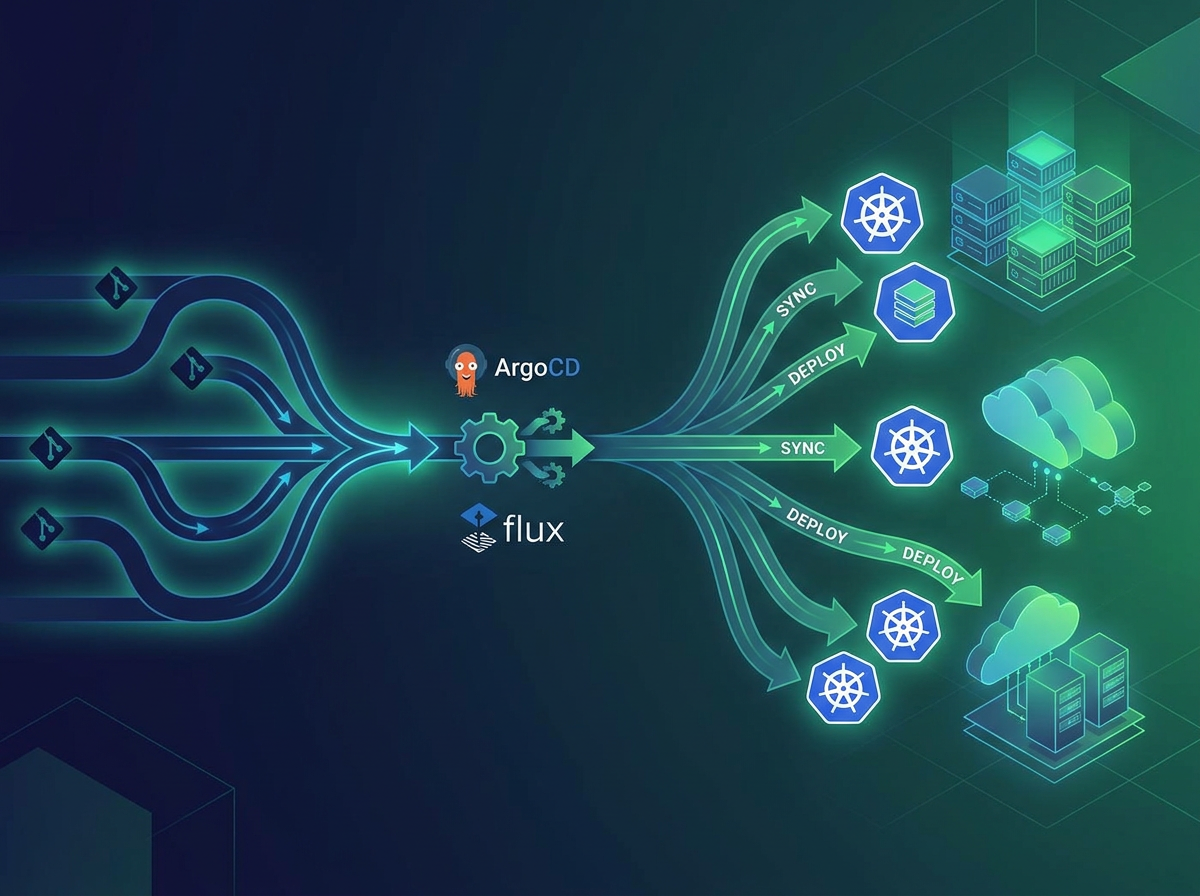
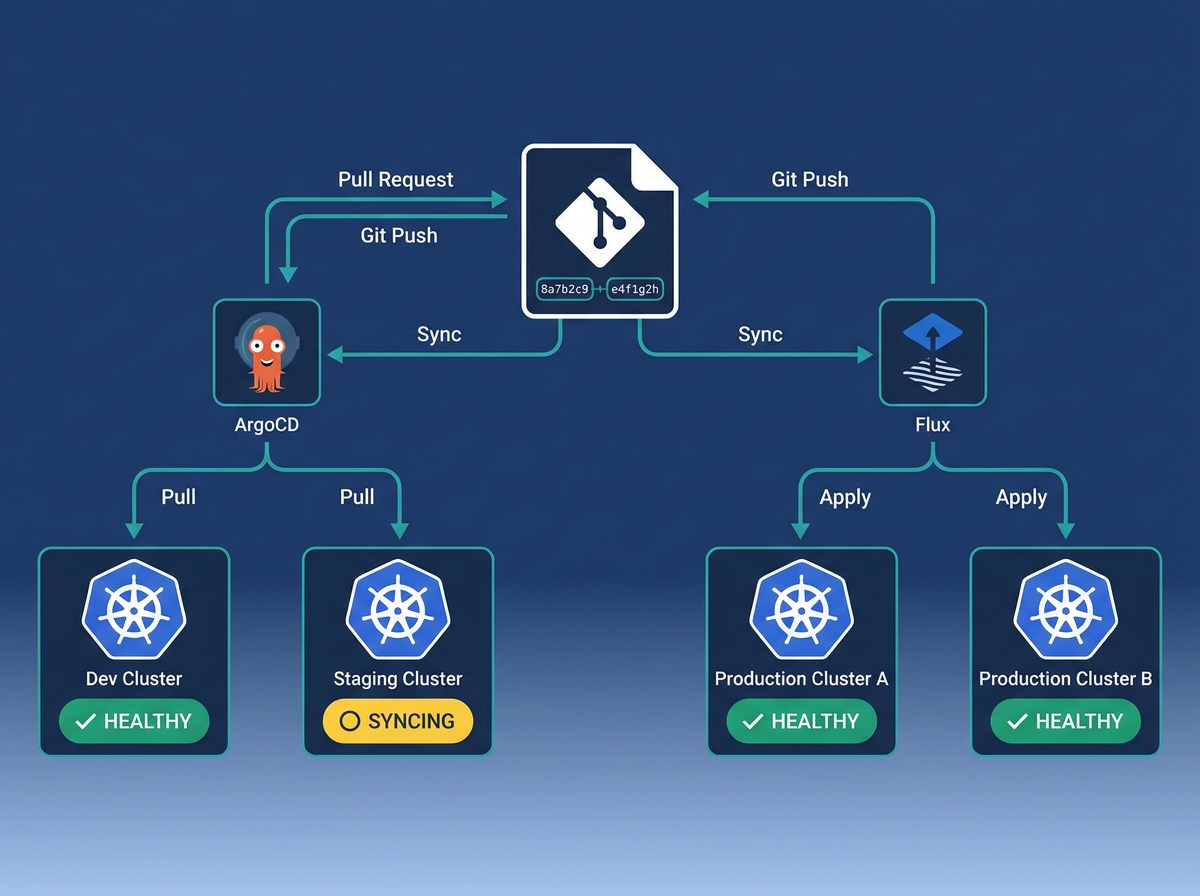
GitOps addresses these problems directly by inverting the model: instead of pipelines pushing to infrastructure, infrastructure controllers continuously pull from Git and reconcile the running state to match the declared desired state.
The Four GitOps Principles
The OpenGitOps working group codified GitOps around four core principles:
Declarative — The desired state of the system is expressed declaratively. Kubernetes YAML, Helm charts, Kustomize overlays — you describe what you want, not how to achieve it.
Versioned and immutable — The desired state is stored in Git. Every change has a commit hash, an author, and a message. The history is immutable. You can always trace when a configuration changed and who changed it.
Pulled automatically — Software agents (ArgoCD, Flux) continuously poll the Git repository and automatically apply changes. No pipeline credentials, no push-based access to production clusters.
Continuously reconciled — Software agents continuously compare the actual state to the desired state. If someone manually changes a resource in the cluster (configuration drift), the agent detects the divergence and automatically corrects it.
ArgoCD vs. Flux: Choosing Your GitOps Engine
ArgoCD and Flux CD are the two dominant GitOps tools for Kubernetes, both graduated CNCF projects. They implement the same GitOps principles differently, and the choice often comes down to team preferences and existing tooling.
ArgoCD takes a more opinionated, application-centric approach. It provides a rich web UI that gives teams visual insight into which applications are in sync, what's drifted, and the history of deployments. ArgoCD's ApplicationSet controller makes it straightforward to manage deployments across multiple clusters from a single configuration. For teams that value UI visibility and have ops engineers who prefer graphical tooling, ArgoCD is often the better fit.
Flux CD takes a more composable, CLI-native approach. Flux is built as a set of Kubernetes controllers that each handle a specific concern — source management, Helm releases, Kustomize overlays, image automation. This makes Flux highly extensible but requires more upfront configuration. Flux's image automation controller (which can automatically update image tags in Git when new container images are published) is particularly powerful for teams running fully automated progressive delivery pipelines.
In practice, both tools are excellent. Large organisations often run both — ArgoCD for application delivery, Flux for cluster bootstrapping and infrastructure management.
Structuring Your GitOps Repository
Repository structure is one of the most consequential decisions in a GitOps implementation. Get it wrong and you end up with a monorepo that's impossible to navigate, or a fragmented multi-repo setup that's impossible to audit.
The most common patterns are:
Monorepo — All cluster configurations, application manifests, and environment overlays in a single repository. Easy to audit (one place to look), complex to manage access controls at scale. Works well for smaller organisations or tightly coupled platform teams.
Repos by environment — Separate repositories for dev, staging, and production. Promotion between environments happens via pull requests (often automated). Cleaner access controls: only senior engineers or automation can merge to the production repo.
Repos by team — Each application team owns their deployment manifests. The platform team owns cluster infrastructure. Requires robust tooling to ensure team repositories follow platform standards. Scales well for large organisations.
Whichever structure you choose, consistency matters most. Document the structure, enforce it with linting and templating, and resist ad-hoc exceptions.
Progressive Delivery with GitOps
GitOps pairs naturally with progressive delivery patterns — canary deployments, blue-green deployments, and feature flags. Tools like Flagger (which works with both ArgoCD and Flux) automate canary analysis: they gradually shift traffic to a new version, monitor error rates and latency metrics, and automatically roll back if success criteria aren't met.
The combination of GitOps + Flagger means you can merge a pull request and have the deployment system handle the entire rollout: automatic canary, automatic analysis, automatic promotion or rollback. Engineers focus on code and configuration; the system handles safe delivery.
Security Considerations
GitOps's pull-based model has inherent security advantages. Because clusters pull from Git rather than CI/CD pipelines pushing to clusters, you don't need to store production cluster credentials in your CI system. The attack surface shrinks significantly.
However, GitOps introduces its own security requirements. Git repository access is now production access — anyone who can merge to the production branch effectively has deploy access. Enforce branch protection rules, require pull request reviews, enable signed commits, and use Sealed Secrets or External Secrets Operator to manage secrets in Git repositories safely.
The Operational Maturity GitOps Provides
Organisations that have made the GitOps transition consistently report the same benefits: faster incident recovery (rollback is a git revert), complete audit trails, reduced configuration drift, and dramatically improved confidence in deployments. The pull request becomes the deployment record — you can look at the Git history and understand exactly what was deployed to production, when, and by whom.
For organisations managing multiple Kubernetes clusters across multiple environments and regions, GitOps isn't just better — it's the only approach that scales with acceptable operational overhead.

How CBM Can Help
Reliable Deployments at Any Scale
CBM implements GitOps programmes that transform how enterprises manage infrastructure. From ArgoCD and Flux implementations to full multi-cluster GitOps architectures — we bring the expertise to make deployments safe, auditable, and fast.
Ready to Get Started?
Reach out for a quick assessment and proposal. Most engagements kick off within days, with a dedicated team aligned to your goals.